A Very Complicated Trail Die
|
  |
| Author |
Message |
wavysteps2003Expert Member
Posts: 1344
Joined: 25 Feb 2005
|
|
 Posted: Fri Apr 27, 2007 1:53 pm Posted: Fri Apr 27, 2007 1:53 pm |
 |
|
For three years I have been working on a solution to find the cause of "wavy steps" and "trails". Up until recntly, I thought that I was close to discovering what was happening on both of both of these anomalies or at least on the right track as to what was causing them.
HOWEVER, sometimes your ideas go up in a poof of smoke when confronted with something that is contrary to what you thought was happening.
The theory of these anomalies being a doubled die is put in serious jepardy by the discovery of this die which I am about to show you. One thing to remember; NO DOUBLED DIE HAS BEEN FOUND THAT HAS TWO DIFFERENT DIRECTIONS OF MOTION. Keeping this in mind, take a look at these pictures.
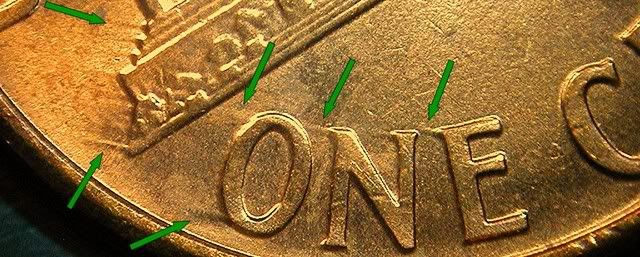
You can see "trails" from the tops of the letters on ONE and the left base of the Memorial building. These "trails" have a direction of 310 degrees.
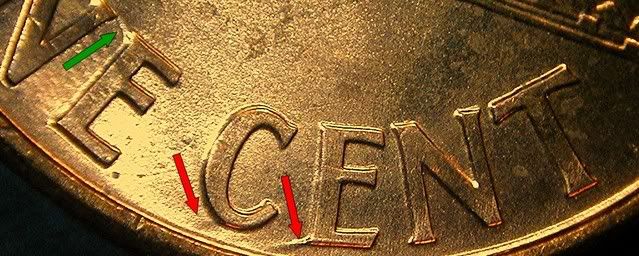
Now the fun begins. The next set of "trails" is on the CE of CENT and have a direcdtion of 240 degrees or 70 degrees difference between the two sets
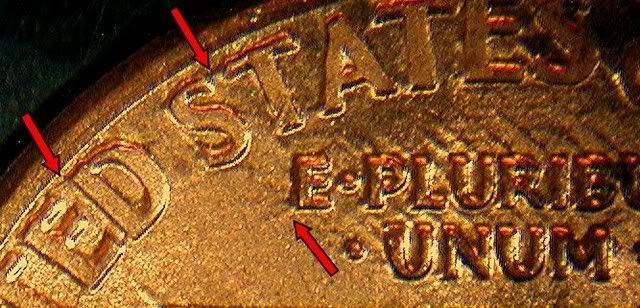
If you look at the E in the EPU, you can see that this element has "trails" in both directions indicated by red arrows for the 240 direction "trails".

The AM of AMERICA also have the 240 degree "trails" with the A having "trails" in the 310 degree direction also.
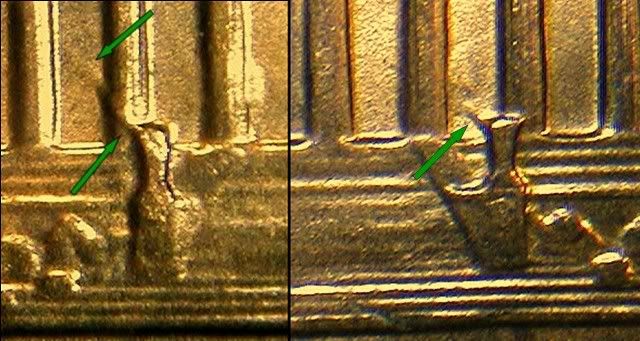
"trails" from both posts (urns)
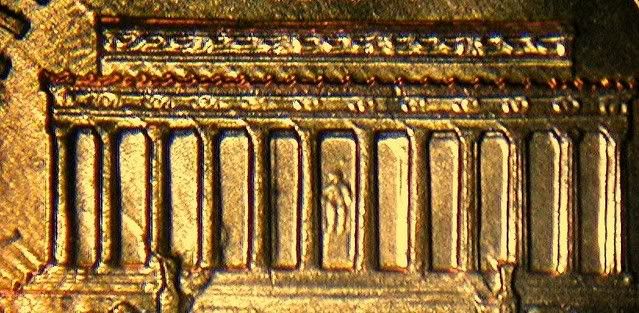
And the last shot, a view of most of the "trails"
This is a confusing die, with no obvious explanation on how this did occur. If you do have any ideas, I would like to hear them with much interest. Thanks for your help.
BJ Neff
_________________
Member of: Coppercoins, ANA, CFCC (VP), CONECA, FUN, NCADD (Editor), NLG, LCR, traildies.com. and MADdieclashes.com
The opinions that I express do not necessarily reflect the policies of the organizations that I am a member of.
Last edited by wavysteps2003 on Fri Apr 27, 2007 3:13 pm; edited 2 times in total
|
|
|
|
|
 |
 RhubarbSenior Member RhubarbSenior Member
Posts: 856
Joined: 24 Jan 2007
Location: West Georgia
|
|
| Posted: Fri Apr 27, 2007 3:01 pm |
|
|
BJ,
Am I correct in saying that die trail's are "deterioation"? I understand little about the trail's theory but very interested in learning.
David
_________________
There is no shame in not knowing; the shame lies in not finding
out.
|
|
|
|
|
|
wavysteps2003Expert Member
Posts: 1344
Joined: 25 Feb 2005
|
|
| Posted: Fri Apr 27, 2007 3:08 pm |
|
|
Hi David - No, they are not detrioration but an actual variety since they are on the die from beginning to end. Trails and wavy steps are one in the same thing and the only difference is the direction that they take.
The coin pictured is an early die state, so detrioration would not have anything to do with it in this condition.
BJ Neff
_________________
Member of: Coppercoins, ANA, CFCC (VP), CONECA, FUN, NCADD (Editor), NLG, LCR, traildies.com. and MADdieclashes.com
The opinions that I express do not necessarily reflect the policies of the organizations that I am a member of.
|
|
|
|
|
|
RhubarbSenior Member
Posts: 856
Joined: 24 Jan 2007
Location: West Georgia
|
|
| Posted: Fri Apr 27, 2007 3:56 pm |
|
|
BJ,
Ok, If a die is new, then the trail's were created by the Hub? Correct?. If I'm wrong please correct me. If so, Does that mean that the Hub is createing the trail's? I'm still learning this stuff and it's getting deep! I'm just trying to understand. Thank's BJ
Your coin is a interesting one. If your confused about it then were all ear's and eye's to find the answer.
David
_________________
There is no shame in not knowing; the shame lies in not finding
out.
|
|
|
|
|
|
 eagamesExpert Member eagamesExpert Member
Posts: 3013
Joined: 15 Nov 2005
|
|
| Posted: Fri Apr 27, 2007 4:37 pm |
|
|
It's more like damage as the hub digs into the die as it centers itself. Just a best guess 
So maybe this one was set up once but not hubbed then reseated and hubbed but the direction of shift was not the same both times.?
_________________
Ed
|
|
|
|
|
|
RhubarbSenior Member
Posts: 856
Joined: 24 Jan 2007
Location: West Georgia
|
|
| Posted: Fri Apr 27, 2007 5:37 pm |
|
|
BJ,
I only as these question's because they have similar characteristict's in what I do for a living.
I am a machinist, I heat-treat different different type's of metal's. I do know that metal's move during this process. Does anyone know the type of metal that the mint use's to press the coin's?
Rhubarb
_________________
There is no shame in not knowing; the shame lies in not finding
out.
|
|
|
|
|
|
wavysteps2003Expert Member
Posts: 1344
Joined: 25 Feb 2005
|
|
| Posted: Fri Apr 27, 2007 7:37 pm |
|
|
David - The mint uses a carbon steel in the dies. I had originally thought that heat may have somethig to do with this, however, from what I have been lead to believe, not enoogh heat is generated during the hubbing process to accomplish the moving of the die.
I have effectively ruled out all the strike related causes, MDD, die detrioration, die abrasion, die cleaning, metal flow (the mint's explanation for these anomalies) or any other affect that is caused by the striking of the coin with the pair of dies.
This is what I know.
Both anomalies exist on the die from the beginning of its life to the end and dimish in intensity as the die ages.
Both anomalies follow certain patterns that are repetative, even over a long expanse of years. I have exact patterns of "trails" on coins from 1994, 1998 and 2004. Wavy steps also follow patterns that are consistent with each other,more so than "trails".
Both anoamlies are due to the single squeeze process and began appearing in 1986, the same year that the Mint began experimenting with that process.
The only denomination that has not been affected by these anomalies is the half dollar. Bob P. recently saw a Washington dollar with "trails" and I saw a Sacawagea dollar with "trails". I have examples of a dime and a quarter in my collection and have pictures of a nickel (the Bison) with "trails".
I have proved that both "trails" and "wavy steps" are one in the same thing with over twenty dies show both anomalies on the same die going in the same direction.
These anomalies have and still are happening on both the obverse and reverse die. More often on the reverse die.
And as I have mentioned before, this is a study on well over 400 different dies that have these anomalies, so I can make some pretty good comparisions with that size data base.
It is hard to imagine how a die could move in two different directions during hubbing unless there is some rehubbing (or multiple hubbing) going on. Also, this is not the only die to have two directional "trails", I have about 7 or 8 more, but none as comp[licated as the one posted.
I'll be honest with you all, it has me stumped.
BJ Neff
_________________
Member of: Coppercoins, ANA, CFCC (VP), CONECA, FUN, NCADD (Editor), NLG, LCR, traildies.com. and MADdieclashes.com
The opinions that I express do not necessarily reflect the policies of the organizations that I am a member of.
|
|
|
|
|
|
 DickExpert Member DickExpert Member
Posts: 5780
Joined: 21 Sep 2006
Location: Rialto, CA.
|
|
| Posted: Fri Apr 27, 2007 11:57 pm |
|
|
Bj, I have been going thru a lot of 2KXX cents yesterday, ad into the wee hours. I ran into the first "trails, that I have ever seen, in hand. It was on the "T", and running about 310 degrees. On the top of the "N" was another. On the bottom was another trail, but runnung about 170 edegrees. I don't remember if I stashed it, or tossed it! These cents are from a lot of 60 rolls that came from AZ. I separated the 2KXX, by year, and the rest by decades. The 70's were first, because of the high number of "P" cents. Obviously, no trails, or wavy steps. Then I went into the '07's, 06's, and '05's. I believe the trails came after those. The case is this: The trails were running in different directions, which I thought was impossible. Have you any way to gain access to: 1, the hub, or 2. One of the working dies to physically inspect it for this phonemena?
Youi at first thought it had to be on the hub. That means that ALL coins struck with that , ( or those hubs), will have to have one, or both anomilies. I have an idea that if one had enough MS 65 ZINC cents from 1982, that there is a chance that there might possibly be traces of one, or both of these conditions. Every one that I have seen in pictures indicate a "Creasing "effect, as in the wavy steps, and "Puckering", in the case of the trails. Or so it seems The actual construction of the cent, lends itself to this theory. The puckering is when something either rises up, or is driven down, as in the letters, or ANY sharp point, for that matter, then the difference in the surface level(s) will show as a"trail", or "ridge", running in a direction, away from the highest point. The opposite effect will occur if the general area is "compressed, as in the lower portiom of the columns, and the steps area, in general. The compression will occur because of the restricting effect of the shape of the devices in that area.. The steps will show a "crease", and the columns will have some "fluting", both cases depending on the inner strength of the planchet. Basically, if you shove something sharp into a softer mass, you will get spreading. Just as when you shove a "hollow" face, or front, as in the letters, and numbers, into the same type of mass there will be "pulling, or "puckering".
It comes down to basic Physics, you know, like the age old case of friction. It produces heat, and heat produces steam, when a cake of ice is involved. I'm sure there are a few of you who know the rest of the question. Maybe even ,the answer!
Later:
BJ, do all the ones with the trails, (like the first one), ALSO have MD? I noticed it , and thought I'd ask.
Dick
_________________
" Deja Moo: The feeling that you've heard this bull before".
|
|
|
|
|
|
 EarwigVeteran Member EarwigVeteran Member
Posts: 287
Joined: 01 Mar 2006
Location: Michigan
|
|
| Posted: Sat Apr 28, 2007 5:09 am |
|
|
Personal opinion is they resqueeze dies that dont pass inspection. With the cost of material goin through the roof and the mint being a self funded entity it only makes cents to cut costs and resqueeze. Rhubarb is right about metel moving in heat treat but it depends on the heat treat cooling process, And there must be a abundance of heat durung the hubbing process. Before the sinle squeeze they used to have to anneal dies between squeezes so it generated enough heat to harden the steel
Eric
|
|
|
|
|
|
 coopExpert Member coopExpert Member
Posts: 3402
Joined: 17 Sep 2003
Location: Arizona
|
|
| Posted: Sat Apr 28, 2007 2:31 pm |
|
|
If they still annealed the metal and it was re-tempered, might that heat distort the die? Not sure if they heat to anneal anymore or not, but if they did that tempering might cause distortion. But the only problem with this theory is that, if they do it to all dies, why are only some affected? So the reason for why there are doubled images/trails/wavysteps/extra bars is still unexplained. The fact is that the doubling is happening regardless of the single squeeze method. I've always wondered if the mechanism was creating these like machine doubles. But after seeing image of the press hubbing the dies, that don't seem possible. There isn't that much tollerance for the process. So, we are still un-sure of how they happen, but because they do, makes them collectable to us.
_________________
Richard S. Cooper
You may be only one person in the world, but you may also be the world to one person.
|
|
|
|
|
|
wavysteps2003Expert Member
Posts: 1344
Joined: 25 Feb 2005
|
|
| Posted: Sat Apr 28, 2007 4:32 pm |
|
|
For those who are not familar with the terms annealing and tempering.
Annealing is the heating of a metal to soften it or turn it away from a more crystaline state. This was the procedure used when multiple hubbing was in use. The newly formed die, due to compression, was in a state called "cold hardening" or a more brittle state. If the die was not heated or annealed, the second hubbing would have shattered the die due to the progression of it becoming into a more crystaline (this is due to the infused carbon into the iron) state. This process was elimenated with the advent of the single squeeze process.
Tempering is again the heating of the metal, however, the big difference is in the way it is cooled. With tempering, the metal is subjected to a rapid heat transfer (cooled fast) which in effect turns the steel towards a more crystaline structure. This is the state of the metal that you would want to strike a coin with. With annealing, the metal is cooled slowly. Tempering is still a procedure that is done to the single squeeze die, to harden it for striking a coin.
As far as the dies affected, that probability is less than .01 % of all the dies made, not many. And to be very honest with you, there are some wavy step / trail dies that show more duplication/distortion/doubling or what ever you would like to call it than some of the more well known doubled dies, including the famous 1955 Lincoln cent doubled die. But then again , the beauty of an object is in the eye of the beholder.
BJ Neff
_________________
Member of: Coppercoins, ANA, CFCC (VP), CONECA, FUN, NCADD (Editor), NLG, LCR, traildies.com. and MADdieclashes.com
The opinions that I express do not necessarily reflect the policies of the organizations that I am a member of.
|
|
|
|
|
|
|
|
|
| Page 1 of 1 |
|
|


