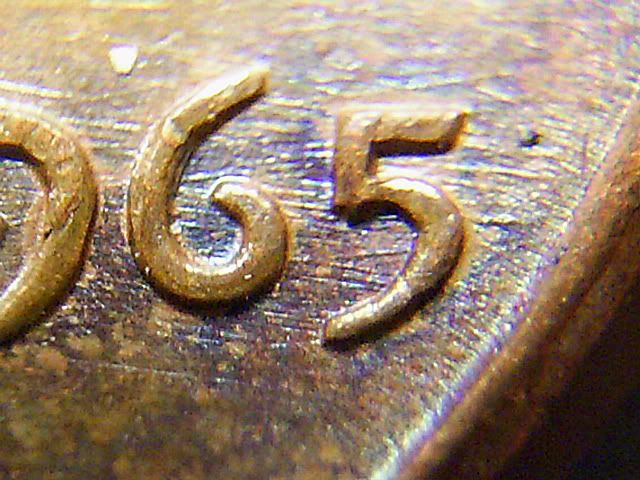
1965-P Repunched Date or Die Gouge?
|
  |
| Author |
Message |
 BankRollsAdvanced Member BankRollsAdvanced Member
Posts: 110
Joined: 13 Apr 2007
Location: Alpena, AR
|
|
 Posted: Wed May 09, 2007 5:12 am Posted: Wed May 09, 2007 5:12 am |
 |
|
The notching in the 5 got my attention.
_________________
Faith is not a leap in the dark, but a step into the light.
|
|
|
|
|
 |
wavysteps2003Expert Member
Posts: 1344
Joined: 25 Feb 2005
|
|
| Posted: Wed May 09, 2007 5:49 am |
|
|
Okay, the first thing; the Mint stop repunching "dates" back in the IHP era. HOWEVER, they continued to repunch digits up until 1986 on the Lincoln cent.
It has been proven that the Mint used a previous year's master hub, with the last two digits of the date abraded off, to create a new master die. That master die then had the last two digits punched into it, which in turn made a new master hub, then master die.
I did an article on the 1946 Lincoln cent, with its inherent weak "46" and the possibilities that the Mint did in fact "repunch" the 4 digit on some of the working dies.
There is also the tilted "5" in the 1956 Lincooln cent that could may very well be a damaged master die that was used as a working die, with the damage being a mis-placed punched error "5" digit. Also suspected are the 1963 Lincoln cents with some of a secondary (to the south) "3" showing. These are classified as a doubled die, however, they also could very well be misplaced punched digits.
I can not remember if the notched "5" on the 1965 Lincoln cent appears on all (or a majority) of that date or not. If it does, then it is a problem with the master die and the possible slip of the punch when that digit was entered into the master die. That would make it a MDO and minor at that which I believe ois the case here.
While we are on the subject, next time that you have a 1986 Lincoln cent in hand, take a look at the last digit, the 6. If you will notice, it is sharper than the three previous digits, the 198. This may be a case where the Mint punched in only the last digit for that year. It was shortly after that when the Mint began using a new galvano for each year.
BJ Neff
_________________
Member of: Coppercoins, ANA, CFCC (VP), CONECA, FUN, NCADD (Editor), NLG, LCR, traildies.com. and MADdieclashes.com
The opinions that I express do not necessarily reflect the policies of the organizations that I am a member of.
|
|
|
|
|
|
 Bob PSite Admin Bob PSite Admin
Posts: 3482
Joined: 01 Jul 2003
Location: Niceville, Florida
|
|
| Posted: Wed May 09, 2007 6:16 am |
|
|
The notching on the 5 of the date is common on all of the 1965 cents. This is noted in Chuck's book. It was a one year type digit, and is normal for the date.
_________________
Bob Piazza
Site Admin/Moderator
Attributer/Photographer
bobp@coppercoins.com
mustbebob1@gmail.com
|
|
|
|
|
|
BankRollsAdvanced Member
Posts: 110
Joined: 13 Apr 2007
Location: Alpena, AR
|
|
| Posted: Wed May 09, 2007 6:25 am |
|
|
Thanks Bob & BJ!
That was allot of GREAT info!
_________________
Faith is not a leap in the dark, but a step into the light.
|
|
|
|
|
|
 coopExpert Member coopExpert Member
Posts: 3402
Joined: 17 Sep 2003
Location: Arizona
|
|
| Posted: Wed May 09, 2007 11:37 am |
|
|
The same notch can be seen on 1959 Cents. If you look through them you will find the same notch on each 1959 Cent. Just part of the design, not a doubled die. But the first time you spot one, you would think it was. I guess the rule of thumb would be if you find what you think is a different design/variety on a coin. Check other ones from the same year. You may find that was the nomal appearance of coins minted that year. Some may have fat letters on EPU with no notching, but compare these to other coins struck that year and you will find out that is just the norm for coin that year.
Some years have master die doubling that was transfered to the hubs, then to the dies. This doubling is noticed on several different dies making it as part of the norm for the year. (1972) Sometimes a damaged punch will appear as a RPM. When you look at coins from different dies, they have the same design with the mintmarks in different locations. At one time they were listed as RPMs till the numbers made we considered. (1972-D I think off the top of my head) The separation, may look the same, locations different and about 20% or more of the coinage was affected. So we then know it was common.
Master die doubling on 1961 Coins catch you off guard as you feel you found something, but is common. I still save the best examples. Some only show a single letter doubled, others show a lot of letters doubled. But ain, the numbers are fairly too large to be die doubling.
Machine doubling is VERY common. From every country you can find these. I found an Austrailian coin that (1966 1 [?]) that you could see die tripling from machine damage. So I guess a rule of thumb is. Compare what you find with regular coins you find from the same year and see if the pattern is happening a lot or just rarely. That might be a clue to if it is a valuable variety or just a normal coin for that year.
_________________
Richard S. Cooper
You may be only one person in the world, but you may also be the world to one person.
|
|
|
|
|
|
|
|
|
| Page 1 of 1 |
|
|


