In regards to Cathy's 2007 Silver Eagle
Goto page Previous 1, 2, 3 Next |
  |
| Author |
Message |
 coopExpert Member coopExpert Member
Posts: 3402
Joined: 17 Sep 2003
Location: Arizona
|
|
 Posted: Thu Oct 04, 2007 3:53 pm Posted: Thu Oct 04, 2007 3:53 pm |
 |
|
I find many proofs do move. I usually looks for the ones with the single image. They are harder to find in my experience. The frosting of the cameo hids doubled dies and strike doubled. so I prefer to check the pre-all cameo coins. I feel strike doubling ruins a coin for me. So I don't get excited about them except for educational purposes. I guess when I do look at current coinage, I pick the best high grade coins to set aside. The rest of the regular coins I put back to work, doing what they were made to do.
_________________
Richard S. Cooper
You may be only one person in the world, but you may also be the world to one person.
|
|
|
|
|
 |
 notabotAdvanced Member notabotAdvanced Member
Posts: 118
Joined: 23 May 2007
|
|
| Posted: Thu Oct 04, 2007 6:43 pm |
|
|
I thought the 57 was a machine double. Is that technically the same as shelf doubling, and I think maybe thats the last question on doubling.
You guys are sure helpful.
Until the next question...
Notabot... 
|
|
|
|
|
|
 DickExpert Member DickExpert Member
Posts: 5780
Joined: 21 Sep 2006
Location: Rialto, CA.
|
|
| Posted: Thu Oct 04, 2007 7:02 pm |
|
|
ED, and others, It could be that the QC, (quality control), is much more "effective" in the case of proof, as opposed to business strikes. Then there is a case if "semantics", and the confusion in therms, that makes it difficult to be more precise,in the terminalogy. I have used "shelf-0doubling, with machine doubling, which I belioeve to be the same thing. Strike doubling is not the same, as it is something that happens when there are "multiple strikes, (as in our older process in minting coins). T he current "single squeeze", is what it implies, just one "hit There is another term that I have used, and I'm not too sure if it is correct. Maybe someone could clarify. I refer to "flat-field doubling". I believe it to be what we see when there is a lateral displacement, due to die erosion, sich as I think is the case on a cent that shows the "movement towards the center of the coin, on the date, and tha same lateral movement on the word "liberty", again toward the center. It is also notaable on the first "T" in trust, again towards the center. The coin is a 1984-D, on about AU-50. Lets see if this works: I sent photos form another unit, IM, and copied them for the forum.
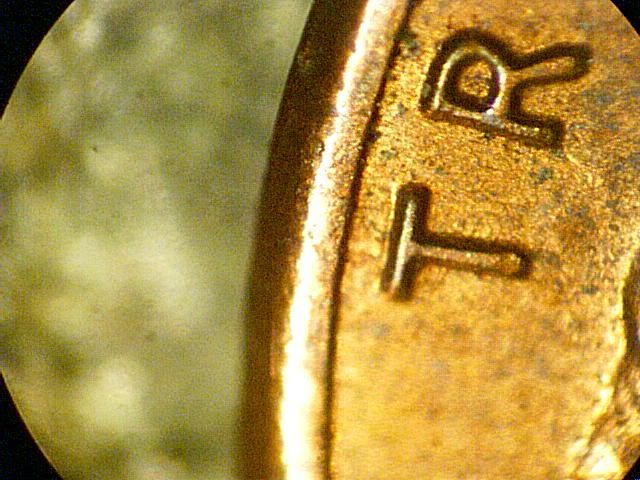
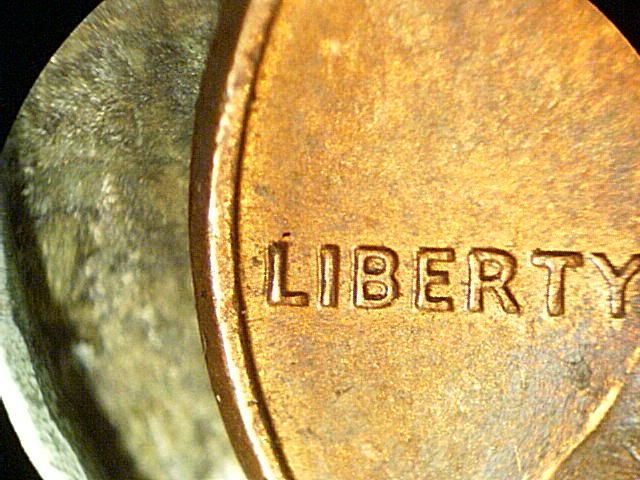
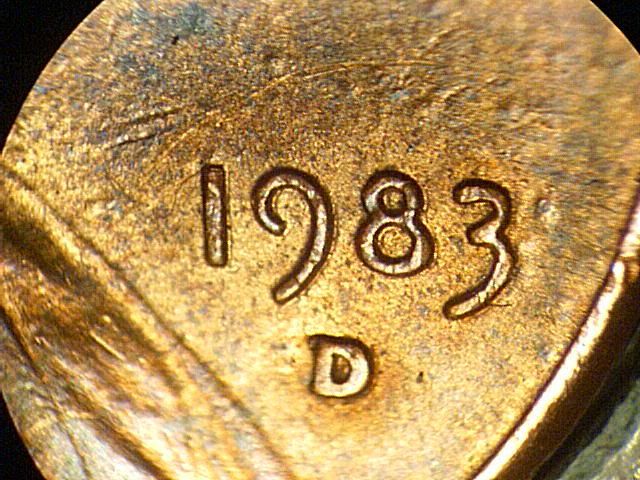
didn't work with IM, but email did.
Dick
_________________
" Deja Moo: The feeling that you've heard this bull before".
|
|
|
|
|
|
coopExpert Member
Posts: 3402
Joined: 17 Sep 2003
Location: Arizona
|
|
| Posted: Thu Oct 04, 2007 7:36 pm |
|
|
Dick: I see that a lot. It looks like the copper plating moved or the die is showing wear. What ever it is it is common. I save extreme example for educational pieces. You see some weird stuff in circulation.
We are looking at things through a microscope, but the mint view stuff we find/collect as as part of the normal process. They don't look as closely as we do.
_________________
Richard S. Cooper
You may be only one person in the world, but you may also be the world to one person.
|
|
|
|
|
|
 eagamesExpert Member eagamesExpert Member
Posts: 3013
Joined: 15 Nov 2005
|
|
| Posted: Thu Oct 04, 2007 8:02 pm |
|
|
I'd agree with Coops terminology, the 57-D should be called machine doubling. (it looks like a shelf)
Dick, the term "single squeeze" is for modern die making (not coin making). They make the dies using single squeeze instead of multiple hubbings. I don't think there ever (in a long time)was a change in the coin striking process, they (by intent) single strike the bus strikes and use multiple strikes on proof coins and I think they did it that way for a long time.
Some coins like the 83 are probably caused by the plating moving or something not tight allowing chatter or on some coins from die wear. That's my guess but once I decide somethings not a doubled die I don't ponder it much more.
Good to see you back online Dick 
_________________
Ed
|
|
|
|
|
|
DickExpert Member
Posts: 5780
Joined: 21 Sep 2006
Location: Rialto, CA.
|
|
| Posted: Fri Oct 05, 2007 12:51 am |
|
|
Coop, ED hi to you both! It has been a while, but like a common cild, you will never quite get rid of me! Ed, I thought the actual minting process was the "single-squeeze", as opposed to the old way of doing it. I knew the proof coins were, (are) multiple strikes, for detail, as opposed to the business strikes. I was not aware that it actuallt occured in the die hubbing process. I guess I'll have to read the "plaid book" again!
Coop, I was pointing out the wat the "false outline was moved towards the center of the coin, as opposed to the lateral movement in the same direction. Yes, I see a lot of that (last movenent laterally, all in same direction), and many times so clear, that one can see it with a small power glass, or even with the naked eye, (one a whole lot better than mine)!
Yes,it is good to be back, It gives my aching abck a rest! I hope you folks can read the text, because many times I look at a key, and end up with another letter than the one expected! My "central vision is very bad, now. Bad enough that I cannot drive any more. The Dr. said my vision , at best with correction would be less than 20/200. My peripheral vision is not affected, so I am not eligible for a white cane. I have always been an excellant speller, but when I proof-read my post, I sure doubt it! Even then a lot gets by, because of the missing parts. Not to worry, I have a daughter who dedicates her spare time to her "Mom, and and Dad", in case we need something.
Diock
_________________
" Deja Moo: The feeling that you've heard this bull before".
|
|
|
|
|
|
notabotAdvanced Member
Posts: 118
Joined: 23 May 2007
|
|
| Posted: Sat Oct 06, 2007 6:41 pm |
|
|
In an interesting word play, Numismatic News calls the newly discovered 1982 cent hub doubling, which confused me at first, but then reading these posts made it all so very clear. Doubled Die is a nuanced term, and varies according to the expert you are talking to about it.   
|
|
|
|
|
|
eagamesExpert Member
Posts: 3013
Joined: 15 Nov 2005
|
|
| Posted: Sun Oct 07, 2007 12:43 am |
|
|
The word hub doubling and doubled die mean the same thing. It means a double image caused by doubling on a die, they call it hub doubling because dies are made by squeezing the hub onto them. (all coins made with the hub doubled die are identical coins of the same doubled die) There are 9 different types of hub doubling. The 9 types don't include double strikes or mechanical or abrasion doubling because those things are not hub doubling/doubled dies like the 9 types listed below.
This is from an old post but I tried to list the 9 types of real doubled dies, these are all the types of hub doubling:
| Quote: |
The classes being reffered to here are the classes of real doubled dies. They would be:
(hey someone might correct me or add to this, I'm still learning or trying to as I look for these real ones)
Class 1 is rotated hub doubling
(die rotated between hubbings making doubling)
Class 2 is distorted hub doubling
(the hub used was in a different condition from one hubbing to another or a totaly different hub so if it was older the older hubs image may be pushed out further toward the rim than the newer hubs image so you see spread to the rim)
Class 3 is design hub doubling
(in some years they had 2 designs like 1970-S large and small date or 1960 large and small so if one hub was different in design you get both different designs)
Class 4 is offset hub doubling
(this would be where the die shifted between hubbings not rotated, maybe up-down-side so you see 2 images shifted not only rotated.)
Class 5 is pivoted hub doubling
(like class one but it rotated on a pivot point other than the center, you might see doubling strong far from the pivot point but not much at the pivot point.)
Class 6 is distended hub doubling
(these are ones where the letters are fat, it might be that the die was treated in some way thermaly maybe causing expansion so when hubbed over another image it just looks fat. I'm not sure this is the only reason for this class, some seem to bend making the letters like the spines of letters look bent so there must be more to it than expansion.)
Class 7 modified hub doubling
(I'm just guessing this one, maybe they changed something like the large to small date or date position and ground away one date then made a modified one so you see a trace of the other... I don't see why it would be called doubled since it's modified and to me it looks like they did it on the masters on most of them... maybe they mean modified with a trace of the initial image still there maybe someone can explain what step it was done at. The only thing that would be doubled is if they used one hub with the date mostly removed then a second with it in a new location but why use the the partial one is ? to me. Look at 1970-D for some examples of this)
Class 8 tilted hub doubling
(maybe the first hubbing is not flat so maybe it just presses in one area, on some the L of liberty or IN of motto then they hubbed it again flat. I think in most cases the second image will hide the first but if combined with another class you might see the tilted partial image then rotated or shifted by the other classes the second image. Maybe the tilted ones can only be seen on coins that also had another class of shift/doubling)
Class 9 single squeeze doubling, is there a better name?
(the doubling we see on the modern ones made with "single squeeze", probably the reason the CPG said the 97 DDO earlobe was not a DDO is at the time this type of doubling was not known but it is now. It seems to be the die shifting durring single squeeze but is not well understood, it could even be that they sqeezed more than once. Most of the time it will cause notching and or widening but not real sep of images)
Some or many ddo's are a combination of classes, I'd think all class 8 must also have another class and like I said I've never heard of a real class 7 and don't understand why they number it at all. For me just being able to see the non real ddo's is the key to finding the real ones regardless of truly understanding what class they might be.
|
_________________
Ed
Last edited by eagames on Sun Oct 07, 2007 12:44 am; edited 1 time in total
|
|
|
|
|
|
 smedSenior Member smedSenior Member
Posts: 624
Joined: 21 Oct 2003
Location: Zephyrhills Florida
|
|
| Posted: Sun Oct 07, 2007 12:43 am |
|
|
| notabot wrote: |
| Doubled Die is a nuanced term, and varies according to the expert you are talking to about it. |
I don't think so. A die is either doubled or it's not -- there are no "shades" of doubling. Some of the so-called "experts", especially the ones espousing "double dies" and "double strikes", don't know their assets from a hole in the ground.
As always, education is key.
_________________
Life Member American Numismatic Association (ANA), Pensacola Numismatic Society
Life Member American Veterans (AmVets), Veterans of Foreign Wars (VFW), Fleet Reserve Association (FRA)
Member Loyal Order of Moose
Member American Legion
|
|
|
|
|
|
eagamesExpert Member
Posts: 3013
Joined: 15 Nov 2005
|
|
| Posted: Sun Oct 07, 2007 12:49 am |
|
|
yep!
If it's a doubled die it's one of the 9 types listed or it's something else. (other than hub doubling / doubled die)
Another detail....
A coin we call a doubled die is a coin that came from a "doubled die".
It does make rock solid sense when you see it that way.
Other types of doubling like strike doubling come from a normal not doubled die striking the coin more than once. Abrasion doubling comes from a worn regular die.
The rule is doubled die coins are made by "doubled dies".
_________________
Ed
|
|
|
|
|
|
notabotAdvanced Member
Posts: 118
Joined: 23 May 2007
|
|
| Posted: Sun Oct 07, 2007 2:39 pm |
|
|
EA Games, thanks for the summary post on doubled dies. Your information is concise. Especially, it is demonstrative of the essential elements of communication.
First, it welcomes the reader.
Second, it is written so as not to alienate the reader with unwelcome negativity.
Third, it thoroughly covers the topic.
Further, it consolidates as much information as is available elsewhere into one spot on the board...a welcome use of indexing with relevance. By reading your post, I was spared the need to search the index proper for my answers.
Once again, thank you for the insightful post.
Others could learn volumes about warm and harmonious interpersonal relations from your writing style, as well as much about our hobby.
|
|
|
|
|
|
smedSenior Member
Posts: 624
Joined: 21 Oct 2003
Location: Zephyrhills Florida
|
|
| Posted: Tue Oct 09, 2007 10:22 am |
|
|
Some people call 'em as they see 'em. Also, not everyone can write flowing prose.
_________________
Life Member American Numismatic Association (ANA), Pensacola Numismatic Society
Life Member American Veterans (AmVets), Veterans of Foreign Wars (VFW), Fleet Reserve Association (FRA)
Member Loyal Order of Moose
Member American Legion
|
|
|
|
|
|
notabotAdvanced Member
Posts: 118
Joined: 23 May 2007
|
|
| Posted: Tue Oct 09, 2007 12:21 pm |
|
|
|
|
|
|
|
|
 GarryNExpert Member GarryNExpert Member
Posts: 1296
Joined: 09 Jul 2003
Location: Chicago
|
|
| Posted: Tue Oct 09, 2007 1:42 pm |
|
|
| eagames wrote: |
The rule is doubled die coins are made by "doubled dies". |
Is there some "flowing prose" there?
|
|
|
|
|
|
coopExpert Member
Posts: 3402
Joined: 17 Sep 2003
Location: Arizona
|
|
| Posted: Tue Oct 09, 2007 5:21 pm |
|
|
Ed: Put some pictures of each class and then you would make it even more educational.
_________________
Richard S. Cooper
You may be only one person in the world, but you may also be the world to one person.
|
|
|
|
|
|
|
|


