| Author |
Message |
 TerybleVeteran Member TerybleVeteran Member
Posts: 316
Joined: 17 Apr 2008
|
|
 Posted: Sun May 25, 2008 7:33 am Posted: Sun May 25, 2008 7:33 am |
 |
|
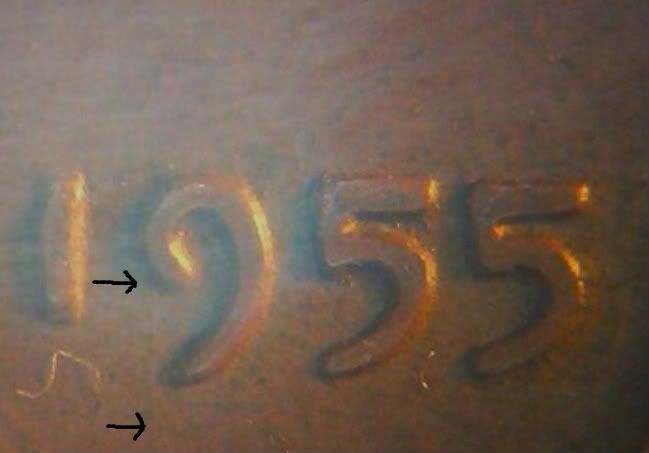
I know Wavey has been real busy, so I thought I'd see if ya'll see what I think I see........  LOL LOL
Thanks, T
_________________
In the 60's, people took acid to make the world weird.. Now the world is weird and people take Prozac to make it normal.
|
|
|
|
|
 |
 StevenExpert Member StevenExpert Member
Posts: 1298
Joined: 30 Nov 2005
Location: S/E Missouri
|
|
| Posted: Sun May 25, 2008 7:49 am |
|
|
|
Looks to be a die scratch to me. Best I can tell.
|
|
|
|
|
|
 coopExpert Member coopExpert Member
Posts: 3402
Joined: 17 Sep 2003
Location: Arizona
|
|
| Posted: Sun May 25, 2008 8:27 am |
|
|
Tery: I think Steven is on the right track, but I will expand a little on the subject. The mark is a die scratch from cleaning but many coins have been made with this die since it happened. Die scratches on the fields do flatten with continued use. Die scratches through devices last longer. Take for examples RPMs that touch the inside of a mint mark. They last a lot longer than ones that go through the field on the outside edges of the mint mark. Die wear just works that way. So I would qualify Steven's statement with this: It is a fading die scratch. What is the difference between a die scratch and a gouge. I would say what caused them. Cleaning with a wire brush will leave multiple die scratches as the brush evenly places several there. a die gouge is when an object is accidently brushed across the dies scratching the field area as that is what is on the out side part of a die. Usually die scratches are smaller than gouges and spread over a wider area. But in your case it may have been one die scratch over a second one making it deeper in that area. So it takes a lot longer to flatten the field in that area. Thus that is why I call it a fading die scratch. The other areas has flatten and no longer seen, but that one is getting almost gone.
When studying coins we think, why couldn't a person make a mark on a coin to look like that? When thatthought comes to mind, take the smallest screwdriver tip or a q-tip or a toothpick and look at it in comparison to the size of your coin under a scope. The object is much larger than you think it would appear under the scope.
Another side point. The idea of trails & wavysteps seem to be only on coins with the single squeeze die making process. The appearance of them started after 1986 I think is the first year that we have seen them. Your coin (1955) was still being made in copper with a multiple step hubbing process. Thus the big DDO for that year. So that also is a reason that it couldn't be trail. Hope this helps?
_________________
Richard S. Cooper
You may be only one person in the world, but you may also be the world to one person.
|
|
|
|
|
|
TerybleVeteran Member
Posts: 316
Joined: 17 Apr 2008
|
|
| Posted: Sun May 25, 2008 9:46 pm |
|
|
I believe and trust your opinions, but please educate me on what reveals the difference in knowing that this appears to be a crack and not a trail. Just the process? How does one tell the difference as this appears to be coming straight down from the 9. Also I do have some coins that have the appearance of spider webs...Lots of them. From what I have learned those would be abrasions from brushing the die? I'm still a little confused about the die and the hub? Some care to explain?
Teryble
_________________
In the 60's, people took acid to make the world weird.. Now the world is weird and people take Prozac to make it normal.
|
|
|
|
|
|
StevenExpert Member
Posts: 1298
Joined: 30 Nov 2005
Location: S/E Missouri
|
|
| Posted: Mon May 26, 2008 8:03 am |
|
|
I will try to answer some of what you are further asking:
1) A die crack is not a part of the coins intended design. Once the die has a stress fracture or crack in it and it is further used to make coins, the pressure of striking forces the metal of the planchet into the crack of the die causing a raised area on the coin matching the crack in the die. The crack will continue to enlarge with continued use of the die transferring the like enlargement to the coins
2) A trail is not yet fully understood but is also an unintended part of the design of the coin possibly created during the hubbing process therefore will transferred to the coins it strikes in like design. With die wear the trails will deteriorate along with the rest of the normal design.
3) What your photo shows is not a die crack it is a die scratch. Which I believe to be placed into the particular die, as an unintended part of the design, by the mint worker cleaning the die. After each cleaning coins struck by that particular die can be further identified by those scratches left by the workers cleaning. As is with the trails, die wear will deteriorate the die scratches along with the rest of the normal design.
Try the following link on hubbing:
http://coins.about.com/od/coinsglossary/g/coin_hubbing.htm
The followin glink is BJ's (wavysteps) and it has an extensive collection of wavystep and trail die photos that would give you a very good visual reference.
http://www.1793.com/resources/traildies/traildies.htm
Hope I am close on this. I am still learning. Being new in comparison to others here in this hobby I am sure that if my analogy is incorrect they will assist with correction.
|
|
|
|
|
|
wavysteps2003Expert Member
Posts: 1344
Joined: 25 Feb 2005
|
|
| Posted: Mon May 26, 2008 10:26 am |
|
|
Hi Teryble - It is a die scratch from the 9. On a normal trail die, there is more than one line from a particular design element.
If you have time, try this little experiment and you will have a better understanding of just trails are formed.
Take a block of children's play-do and flatten it out. Then with a ruler, impress a series of parallel lines into the play-do with a straight edge ruler. Next, take a fork and drag it through the parallel lines perpendicularly.
If you will notice that at the intersections where the fork is drug through the parallel lines, those lines tend to bend toward the motion of the drag made by the fork.
Now, if you have a wavy step handy, take a look at it and you will basically see the same affect that makes the steps "wavy". The same principle applies to "trails" with the only exception being that trails happens on other places of the obverse and reverse dies, while "wavy steps" only happens on the Lincoln Memorial building. To answer another question that I know is coming, "yes", when a trail passes over another design element, there is the same tendency to drag that intersecting line in the same direction as the trail line.
BJ Neff
_________________
Member of: Coppercoins, ANA, CFCC (VP), CONECA, FUN, NCADD (Editor), NLG, LCR, traildies.com. and MADdieclashes.com
The opinions that I express do not necessarily reflect the policies of the organizations that I am a member of.
|
|
|
|
|
|
coopExpert Member
Posts: 3402
Joined: 17 Sep 2003
Location: Arizona
|
|
| Posted: Mon May 26, 2008 1:27 pm |
|
|
Die scratches can be straight or curved.
Die cracks tend not to be straight. The meander according to how the metal was cracked.
Hubbing is a step in the precess of making a die. If you were to look at a hub, the design would be the same as what you see on the cent. This pattern is transfered to the die with a pressing of the hub into the metal prepaired to be a die. After the hubbing is complete, the die can be put to use after an inspection to make sure it is up to standards. The die is a negative of the hub and makes coins that is the same view as the hub. Before the single squeeze process (Which they use today) the hubbing happened several times on cents and as many as twelve times for the larger coins.
Don't worry about questions. We love them and learn from questions as well. The forum being a continous process covers some questions over and over, BUT with perhaps a little different expression from different posters. So keep them coming. I notice that questions go down until we get new members.
_________________
Richard S. Cooper
You may be only one person in the world, but you may also be the world to one person.
|
|
|
|
|
|
 eagamesExpert Member eagamesExpert Member
Posts: 3013
Joined: 15 Nov 2005
|
|
| Posted: Tue May 27, 2008 1:02 pm |
|
|
Most trails are in groups so you would see them from several places.
Just my own note..... To me scratches and gouges and cracks seem sharper than trails. Most trails that I see have a sort of soft rounded look.

_________________
Ed
|
|
|
|
|
|
eagamesExpert Member
Posts: 3013
Joined: 15 Nov 2005
|
|
| Posted: Tue May 27, 2008 1:03 pm |
|
|
Most trails are in groups so you would see them from several places.
JUST ADDING:
(scratches or gouges can also be in groups so be careful)
Just my own note..... To me scratches and gouges and cracks seem sharper than trails. Most trails that I see have a sort of soft rounded look.
_________________
Ed
|
|
|
|
|
|
|


