Repunched devices versus doubled dies.
|
  |
| Author |
Message |
 KurtSSenior Member KurtSSenior Member
Posts: 875
Joined: 15 Feb 2008
|
|
 Posted: Sat Nov 29, 2008 11:45 pm Posted: Sat Nov 29, 2008 11:45 pm |
 |
|
How easy is it to tell doubled dies from repunched letters and dates? 
At the last show, I came across a few coins that I initially could not tell whether the coin had a repunched date/device, or is actually a doubled die.
The first case is a Norway 50 ore, where I thought the date was "repunched", until closer inspection revealed some details pointed out below.
One point I considered: were dates "repunched" separately on many coins in 1948—or is this the effect of double-hubbed die?
Take a look at the photo and click for an enlargement of details. What do you think?
(click to see full resolution)

The second coin is a Sweden 1904 2 ore, which I picked for its nice grade and lower mintage of 698K.
Taking a closer look, I noticed something very interesting on the "N" in the devices, as shown below in the detail.
What do you think is going on here? I have vacillated between a doubled die and a repunched letter because
I'm skeptical that 20th century coins had letters punched individually into dies.
On the other hand, if the N was offset that much by a second hubbing, shouldn't I see doubling in the top serifs of the E?
While I did spot slight doubling in the base of the A (second detail), I'm not positive the two are related.

On the other hand, I consider a sure sign of a repunched device when there are different offsets and directions between adjacent letters or numbers.
A good example here is this 1 ore coin from 1858, where the two digits "85" are unmistakably repunched in the date.
Here the 5 is pretty obvious, and the 8 shows a distinctive pronged shape where an 8 was repunched below the main digit (top detail).

Doing a careful tracing of these digits, I find that I cannot account for both RPDs by repunching of the present date arrangement.
If I align the tracing to the 5, it does not work for the 8, or vice versa. The last detail approximates the offset for the 8 and 5,
reinforcing a different position for the previous pair. This could mean a few things, such as the digits were punched independently (not using a gang punch), or possibly the date
was punched over an already dated die--or lastly a die from a previous year was re-used (ie an overdate). But here I don't consider an overdate necessary to explain what I see on the coin,
since there is no clear evidence of a second digit under the last 8. Just a few initial thoughts--please feel free to add comments below. 
|
|
|
|
|
 |
 JRoccoVeteran Member JRoccoVeteran Member
Posts: 418
Joined: 08 Oct 2004
|
|
| Posted: Sun Nov 30, 2008 9:39 am |
|
|
Hey Kurt, How are you?
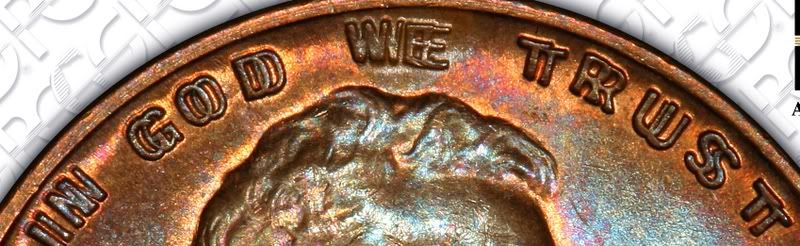
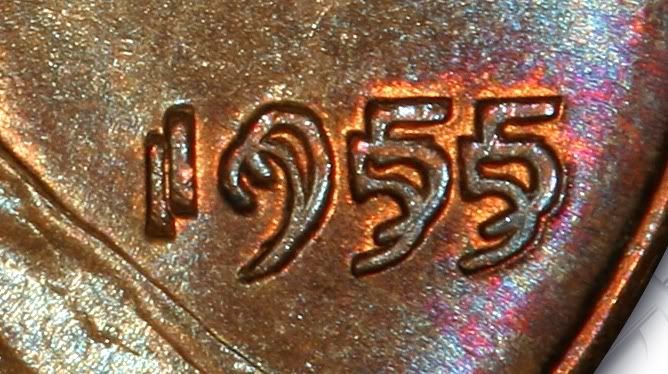
To get to your topic. A doubled die is a die that has been struck by a master die at least twice that had one of the strikings misaligned (eg rotated)with a previous striking. Take the 55 DDO for example-easy to see the second hubbing was obviously rotated in relation to the previous strike. In this instance the master die had a complete design that it transferred to the working die. The only addition to the working die would be the addition of a punched mint mark to the die.
Compare this to a Capped Bust Half Dollar for example. Here the master die hubbing only included the most basic elements of the design like the eagle on the reverse with the shield outline. The shield lines, lettering,obverse stars etc were all punched or engraved individually the same way a mint mark is punched into a 1950's Lincoln.
On the 1955 DDO for example, the entire date was doubled as well as all the elements at the same time. Look at this close-up on my 55 DDO for example.
Now on this 1776 Russian copper as a comparison, every number of the date was hand punched into the working die so the first 1 was punched a little too low on this die and they corrected or re-punched it a little higher to correct the die.
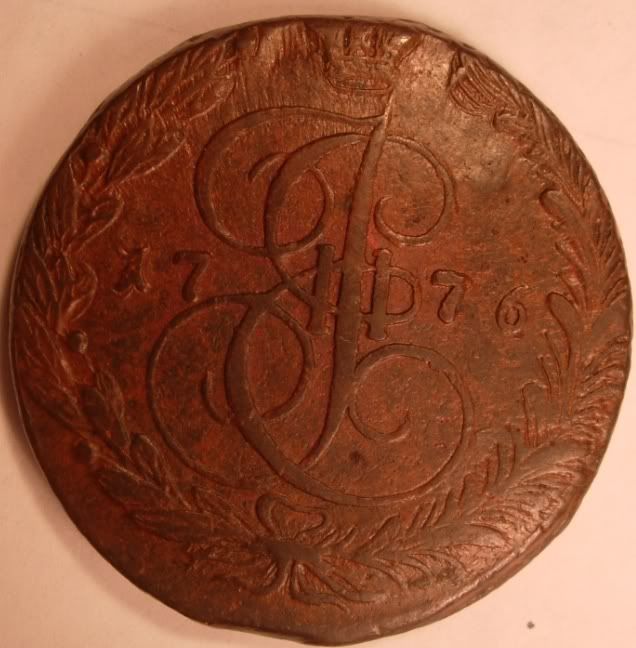
And it looks like it took them at least 3 tries to get this one right.
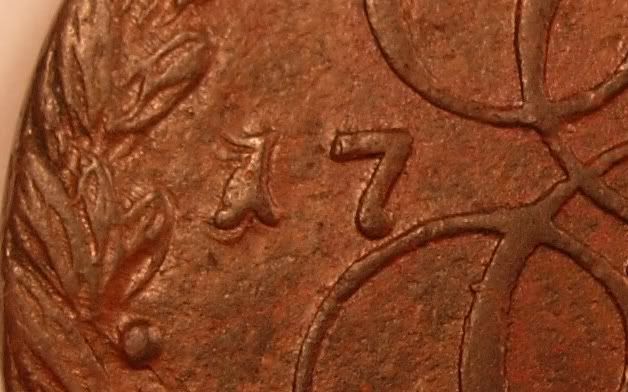
So in short, I guess the answer would be that you have to know how the die was made. If the doubling is the design itself from the master die that was hubbed with the doubling onto the working die or if the doubling was a separately punched element onto the working die would determine if it is referred to as a doubled die or a re-punched die.
I hope that made sense.
_________________
John
|
|
|
|
|
|
KurtSSenior Member
Posts: 875
Joined: 15 Feb 2008
|
|
| Posted: Sun Nov 30, 2008 10:26 am |
|
|
Hi John, I enjoyed your posts of the medals you collect--very nice! That's an excellent '55 DDO too!
The 1 digit on the 1776 copper is a great example of an obvious triple punched digit.
I find it surprising that as late as 1844 (perhaps later still) coins of the UK had devices punched individually into dies, and not just dates.
Here's an example of an 1844 Half Farthing, where the E was punched over a misplaced N in REGINA.
Comparing this coin to others from that year shows the letters for the legend were punched individually into each die.

And agreed--it would sure help to know the die-making process, although I've found it's not always possible to get those records, even for the 20th C.
In these cases, I think the coin itself could provide some evidence of the process. Here I can be reasonably sure that a date on a coin from 1948 was re-hubbed,
but I'm not so sure for that 1904 ore. Given how the top serifs on slightly different lengths on the right, may suggest a reworked/repunched letter.
I'll need to research this one more...thanks!
|
|
|
|
|
|
JRoccoVeteran Member
Posts: 418
Joined: 08 Oct 2004
|
|
| Posted: Sun Nov 30, 2008 10:47 am |
|
|
Then you come across a coin that makes you just scratch your head.
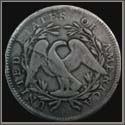
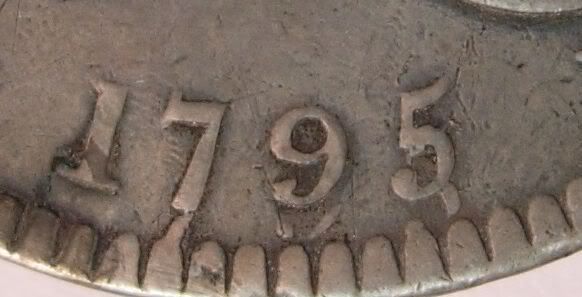
I look at my 1795/1795 Flowing Hair Half Dollar and see a complete repunched date and wonder...what were they doing? This was during the time when each number was punched into the die individually yet the 175 were punched really low yet lower than the 9. The 1, 7 and 5 all touch the milling but the 9, while punched very low the first time does not touch the milling ??? What the heck.
_________________
John
|
|
|
|
|
|
KurtSSenior Member
Posts: 875
Joined: 15 Feb 2008
|
|
| Posted: Sun Nov 30, 2008 11:46 am |
|
|
John, that's a great 1795 dollar! 
I really like coins like this that give an indication of the die-making process.
It's interesting to see how these digits were clearly repunched independently,
versus the gang type punch used later on Flying Eagle and Indian Head cents.
That's a pretty wild repunching to go into the denticles.
There are a few IHCs with digits this low, and some believe it was done to test die hardness.
I have one IHC where the whole date was punched 4 times in the denticles--only a few tops of digits protrude into the field.
|
|
|
|
|
|
|
|
|
| Page 1 of 1 |
|
|


